
Exploring Cultures: The Lewis cross-cultural communication model
- Roy Edwards
- Jun 22, 2025
- 2 min read
Updated: Mar 21

In the blog last week, we focused on the Hofstede argument that attempts to differentiate societies based of distinctive value dimensions. This week, we will explore the model developed by Lewis on the critical practical issue of understanding contrasting cross-cultural communication styles.
Introduction to the Lewis model
Lewis, an expert on both culture and languages, based his model on extensive cross-cultural research focusing specifically on factors such as behavioural expectations and time orientation. In essence, his approach is an attempt to simplify the process of intercultural communication that resulted in the categorisation of three main types of communication style labelled as linear-active, multi-active, and reactive.
Overview of the Lewis categories
Linear-Active | Multi-Active | Reactive |
|---|---|---|
Talk half the time | Talk most of the time | Listen most of the time |
Do one thing at a time | Do several things at a time | Reach to actions |
Plan each step | Plan general outline | Look at principles |
Polite but direct | Emotional | Polite and indirect |
Partly conceal feelings | Display feelings | Conceal feelings |
Confront with logic | Confront with emotions | Avoid confrontation |
Rarely interrupt | Often interrupt | Do not interrupt |
Job-orientated | People-orientated | Very people-orientated |
Limited body language | Unlimited body language | Subtle body language |
Truth before dishonesty | Flexible truth | Dishonesty over truth |
Sometimes impatient | Impatient | Patient |
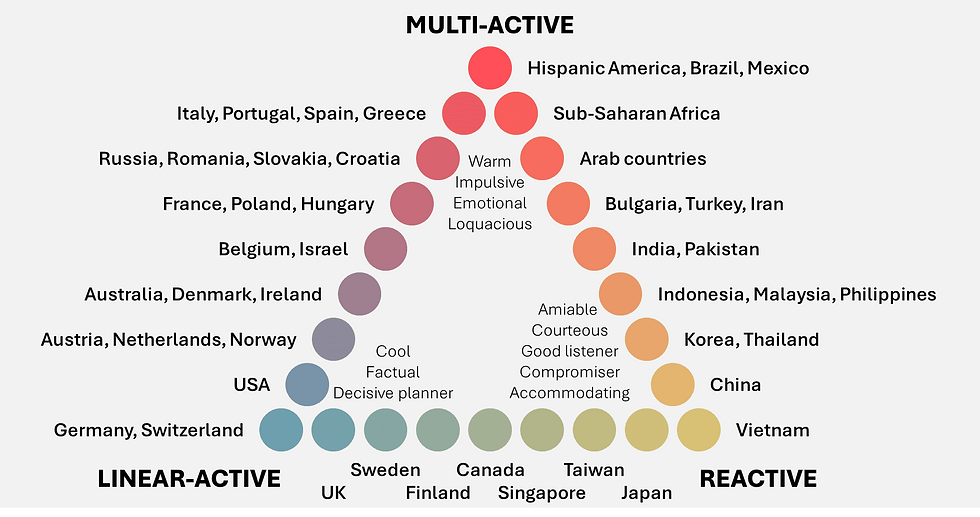
On this basis, Lewis created a comprehensive model in which he placed all the major nationalities on a single scale called the Culture Triangle.
Consequential communication challenges
Perhaps most controversial argument is that, while communication between linear-active and reactive participants normally be experienced as relatively comfortable, both could struggle during the multi-active interactions. The reason proposed for this is that multi-active participants enter negotiation with only the vaguest outline of an objective, tend to over talk other members consistently, while further disrupting procedure of occasional emotional outburst.
In conclusion, while the Lewis communication developmental approach is justifiably regarded a most simple and practical model of cross-cultural communication, this also highlights the primary potential weakness. Put simply, this approach is open to rather simplistic stereotyping that could prejudice expectations even prior to intercultural encounters.
Question 1
Could open expressions of emotion really disrupt cross-cultural communication?
Question 2
How might a focus on behavioural role expectations limit cross-cultural understanding?
Question 3
Why is it important to understand the deeper levels of unfamiliar cultures?
We shall explore Question 3 in the next blog.
Reference
Lewis, R. D. (2005). When cultures collide: leading across cultures (3rd ed.). Nicholas Brealey International


Comments